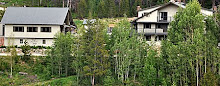
Fire weed is a dramatically beautiful plant with striking purple blossoms. Consisting of a long stalk, it flowers sequentially through the summer, with the blossoms climbing higher on the plant as summer progresses. Children in Grand County are said to get sad when the blossoms at the apex of the plant begin to flower, because it is an indication that the beginning of school is imminent.
Fireweed is so-named because it is one of the opportunistic plants that sprout in the forest after a fire. With their tenacious roots, they secure the soil and make it possible for less-vigorous plants subsequently to take root.
After the blossoms reach the top of the plant, you think it's pretty much done for. All that's left are these long narrow tubes. But just when you think the thing is done for and about to die, the tubes split open and begin to release so much fluff that you're sure they could give a cottonwood a run for its money.
Fireweed fluff is a harbinger of fall and a promise of more substantial (and significantly colder) white stuff that pretty soon is going to start falling from the sky and not from ruptured plant stamens.
I wish that the amount of fireweed fluff were a predictor of a good snow season. If that were true, then the High Mountain Lodge (and the Fraser Valley and Winter Park Ski Area) promise to be buried in the skiable and snowshoe-able white stuff this winter.
The other day, Julie said to me, "I am so looking forward to winter! Aren't you?" Well, yeah. After I replace the weather stripping on most of the doors in the lodge. And I really need to take apart our Buick-sized snowblower that has been summering down in the green shed. I'm pretty sure that bad boy is gonna earn his keep starting in just a few months.
We'll be ready. We're looking forward to having winter sports enthusiasts in the lodge. We can hardly wait to get out our own skis and snowshoes.
In the meantime, we'll sit out in the sunshine under the umbrellas on the Lodge decks, watch the wheeling sky that is always different, with the beauty of any one day trying to out-do the day before.
Mind you, we're not it a hurry for it to snow, but the promise of winter has us filled with anticipation.
Sunday, August 29, 2010
Friday, August 20, 2010
Fitted Sheets
When I went off to college many many years ago, my first roommate was a guy whose dad owned a dry cleaning plant and laundry somewhere in the wilds of Kansas.
Bill came to school armed with flat sheets for his bed--but no fitted bottom sheets. Instead, he was expected to wrap his mattress in one of the flat sheets. It seems that his father was consumed with hate-filled rage whenever he encountered a fitted bottom sheet, courtesy of the folding machines at his laundry being unable to do anything but tie the cloth in knots. Bill told me that he'd seen his dad purple with rage trying to unwind a fitted bottom sheet from one of the laundry's state-of-the-art sheet folders.
At the time, it seemed a rather excessive reaction to the convenience of a fitted bottom sheet, especially since Bill's dad, despite his rage, hadn't bothered to teach his son how to make a bed using a flat sheet for a bottom sheet.
After a few days of waking up when Bill fell on the floor when his alarm went off wrapped up in his sheets like an Egyptian corpse somebody had done a bad job of embalming, I finally took pity on him and showed him how to do military corners that you could bounce a dime off of after sleeping on the sheet all night long.
I wasn't a particularly militaristic person, and this was during the Vietnam War, when every eighteen-year-old male was trying to find some ethical reason to avoid the draft. I didn't learn my bed-making skills from the military or militaristic parents, but from a terrifying nurse in an osteopathic hospital who could make the most arrogant doctor tremble and sweat--and sometimes weep. My first high-school job was as a hospital orderly, and this nurse taught me how to unfold a sheet, put it on the bed, pull the fabric so tight you could have sent semaphore messages by tapping on it, then tuck the corners in so tightly that nothing could have escaped that mattress. She actually taught me how to tuck a sheet in so tight that an alcoholic suffering from delirium tremens couldn't escape. "It's kinder than puttenem in a straightjacket," she told me.
"Yes, ma'am," I replied.
That nurse taught me how to make a bed so tight it would make a marine drill sergeant weep, it was that beautiful. I could make a bed with a person still in it with the sheets so perfect that it wouldn't be wrinkled the next day. When it came to bed-making, I was a god.
Fast forward a couple (ok, three) decades. My wife and I buy a 13-room Bed & Breakfast. We have a lot of sheets to wash. And suddenly, I am transported back to my undergraduate years and my first roommate's stories about his dad's rage against fitted sheets.
I suddenly love this man.
After a year of inn-keeping, I'm finally pretty good at folding a fitted bottom sheet. Sort of. It depends on how exhausted the elastic is. The more un-elastic the elastic is, the nicer the fold is going to be, and the better the sheet will look when it's wrestled onto the bed.
On the other hand, if it's one of our newer sheets with elastic all around, then no matter how carefully it's folded, the wrinkles on the sheet when we get it on the bed are inevitably going to resemble a Dan Brown map on how to find gold in the cave of the Knights Templar.
At the High Mountain Lodge, we iron the top sheets and we iron the pillow cases, but those damn bottom sheets have defeated us. Please don't think the less of us for our failure!
And Bill, God bless your dad. The things you told me about him scared the, uh, they really scared me. I sure hope he was reconciled to the deficiencies of his ironing machines before he retired.
Bill came to school armed with flat sheets for his bed--but no fitted bottom sheets. Instead, he was expected to wrap his mattress in one of the flat sheets. It seems that his father was consumed with hate-filled rage whenever he encountered a fitted bottom sheet, courtesy of the folding machines at his laundry being unable to do anything but tie the cloth in knots. Bill told me that he'd seen his dad purple with rage trying to unwind a fitted bottom sheet from one of the laundry's state-of-the-art sheet folders.
At the time, it seemed a rather excessive reaction to the convenience of a fitted bottom sheet, especially since Bill's dad, despite his rage, hadn't bothered to teach his son how to make a bed using a flat sheet for a bottom sheet.
After a few days of waking up when Bill fell on the floor when his alarm went off wrapped up in his sheets like an Egyptian corpse somebody had done a bad job of embalming, I finally took pity on him and showed him how to do military corners that you could bounce a dime off of after sleeping on the sheet all night long.
I wasn't a particularly militaristic person, and this was during the Vietnam War, when every eighteen-year-old male was trying to find some ethical reason to avoid the draft. I didn't learn my bed-making skills from the military or militaristic parents, but from a terrifying nurse in an osteopathic hospital who could make the most arrogant doctor tremble and sweat--and sometimes weep. My first high-school job was as a hospital orderly, and this nurse taught me how to unfold a sheet, put it on the bed, pull the fabric so tight you could have sent semaphore messages by tapping on it, then tuck the corners in so tightly that nothing could have escaped that mattress. She actually taught me how to tuck a sheet in so tight that an alcoholic suffering from delirium tremens couldn't escape. "It's kinder than puttenem in a straightjacket," she told me.
"Yes, ma'am," I replied.
That nurse taught me how to make a bed so tight it would make a marine drill sergeant weep, it was that beautiful. I could make a bed with a person still in it with the sheets so perfect that it wouldn't be wrinkled the next day. When it came to bed-making, I was a god.
Fast forward a couple (ok, three) decades. My wife and I buy a 13-room Bed & Breakfast. We have a lot of sheets to wash. And suddenly, I am transported back to my undergraduate years and my first roommate's stories about his dad's rage against fitted sheets.
I suddenly love this man.
After a year of inn-keeping, I'm finally pretty good at folding a fitted bottom sheet. Sort of. It depends on how exhausted the elastic is. The more un-elastic the elastic is, the nicer the fold is going to be, and the better the sheet will look when it's wrestled onto the bed.
On the other hand, if it's one of our newer sheets with elastic all around, then no matter how carefully it's folded, the wrinkles on the sheet when we get it on the bed are inevitably going to resemble a Dan Brown map on how to find gold in the cave of the Knights Templar.
At the High Mountain Lodge, we iron the top sheets and we iron the pillow cases, but those damn bottom sheets have defeated us. Please don't think the less of us for our failure!
And Bill, God bless your dad. The things you told me about him scared the, uh, they really scared me. I sure hope he was reconciled to the deficiencies of his ironing machines before he retired.
Thursday, July 22, 2010
The Summer of the Hummingbird
In keeping with Native American and Asian ways of remembering events, the summer of 2010 at the High Mountain Lodge promises to go down in the Beckwith Family Annals as the Summer of the Hummingbird.
As I write this out on the deck of the High Mountain Lodge, a swarm of 12 to 18 hummingbirds (surely the collective noun for hummingbirds must be a "swarm" and not a "charm" as one website reports) are fighting a pitched battle over the feeder we installed on the balcony outside our bedroom. We have another, similar feeder hanging outside our sitting room balcony, and an even larger one hanging outside the windows of the dining room.
We are filling the feeders at least twice a day. We have almost gone through the 50-pound bag of sugar we bought at Costco in Denver in late spring to feed the two hives of bees we are keeping down in the hayloft of the ruined barn on the property. We've only filled the feeders for the bees twice; the hummers have sucked down all the rest.
It has gotten to the point where, when the feeders are empty, the hummingbirds will fly up in our face as if to remind us to feed them. This afternoon when I filled the big feeder off the dining room, the moment I cranked open the window to get to the feeder, I had three hummers buzzing around impatiently; they turned angry when I took the feeder away, and when I brought it back a full ten minutes later two of them landed on the perches before I even had a chance to hang it on the hook outside the window.
One flew into the office this afternoon when Julie was figuring out the sales taxes, and later I found another one trapped in the dining room trying to get to the feeder outside the window. I had to catch it and gently shoo it out the window. It immediately flew to the feeder, not a bit the worse for wear.
These creatures are fearless and violently territorial. Years ago, Julie and I visited a couple who, in their retirement, had bought an alfalfa farm down by Cortez, Colorado. At the time, we thought they were insane to work that hard in their retirement; that was before we bought the High Mountain Lodge.
Anyway, we were having breakfast one morning, and I commented on how scrappy the birds were (I'd never seen that many in one place before, being an Oklahoma boy). "Yeah," said our friend, "if they were any bigger, we'd have to shoot 'em."
At the time, I thought she was exaggerating, but a few mornings ago, when it had been warm enough overnight to leave the sliding glass door open to our balcony, the hummers started fighting over the feeder at 4:30 a.m. The noise woke both Julie and me up. Perhaps a better collective noun might be "an annoyance of hummingbirds."
We have created a monster--a collective monster. The peace and quiet of the High Mountain Lodge is now punctuated by the various and varied noises hummingbirds make. Earlier today, I was in our sitting room and began to wonder if Denver air traffic control had, for some reason, begun to divert airplanes over Grand County. But no, it was just the hummingbirds at the feeder--two, and sometimes three trying to feed from the same station.
Looking West from the Deck of the High Mountain Lodge
As I write this out on the deck of the High Mountain Lodge, a swarm of 12 to 18 hummingbirds (surely the collective noun for hummingbirds must be a "swarm" and not a "charm" as one website reports) are fighting a pitched battle over the feeder we installed on the balcony outside our bedroom. We have another, similar feeder hanging outside our sitting room balcony, and an even larger one hanging outside the windows of the dining room.
We are filling the feeders at least twice a day. We have almost gone through the 50-pound bag of sugar we bought at Costco in Denver in late spring to feed the two hives of bees we are keeping down in the hayloft of the ruined barn on the property. We've only filled the feeders for the bees twice; the hummers have sucked down all the rest.
It has gotten to the point where, when the feeders are empty, the hummingbirds will fly up in our face as if to remind us to feed them. This afternoon when I filled the big feeder off the dining room, the moment I cranked open the window to get to the feeder, I had three hummers buzzing around impatiently; they turned angry when I took the feeder away, and when I brought it back a full ten minutes later two of them landed on the perches before I even had a chance to hang it on the hook outside the window.
One flew into the office this afternoon when Julie was figuring out the sales taxes, and later I found another one trapped in the dining room trying to get to the feeder outside the window. I had to catch it and gently shoo it out the window. It immediately flew to the feeder, not a bit the worse for wear.
These creatures are fearless and violently territorial. Years ago, Julie and I visited a couple who, in their retirement, had bought an alfalfa farm down by Cortez, Colorado. At the time, we thought they were insane to work that hard in their retirement; that was before we bought the High Mountain Lodge.
Anyway, we were having breakfast one morning, and I commented on how scrappy the birds were (I'd never seen that many in one place before, being an Oklahoma boy). "Yeah," said our friend, "if they were any bigger, we'd have to shoot 'em."
At the time, I thought she was exaggerating, but a few mornings ago, when it had been warm enough overnight to leave the sliding glass door open to our balcony, the hummers started fighting over the feeder at 4:30 a.m. The noise woke both Julie and me up. Perhaps a better collective noun might be "an annoyance of hummingbirds."
We have created a monster--a collective monster. The peace and quiet of the High Mountain Lodge is now punctuated by the various and varied noises hummingbirds make. Earlier today, I was in our sitting room and began to wonder if Denver air traffic control had, for some reason, begun to divert airplanes over Grand County. But no, it was just the hummingbirds at the feeder--two, and sometimes three trying to feed from the same station.
Thursday, July 15, 2010
The Birds & The Bees at the High Mountain Lodge
Went to feed the bees the other day and got stung. We have two hives in the hay loft of our ruined barn down below the High Mountain Lodge.
By the time the wasps, annoyed at the immolation of their home, began to sting me, dad was too busy to pay much attention to my predicament. The paint around the nest had begun to blister and the wood of the soffits to char. He was whacking at the burning paper hornet's nest with the burning rag and splattering drops of inflamed kerosene-soaked rag ash all over the place. It wasn't the best way to try to put out the fire.
Nor was my mother any help. When I ran screaming into the house because of the stings, she, hearing my shrieks and knowing my dad, had rushed out of the house fearing he'd set it on fire and wanting to give him advice on how to put out the blaze at the top of her lungs.
I was left in the house alone, moaning and rubbing the stings, which only made them hurt worse. By the time Mom and Dad came back inside extrovertedly triumphant, having cooled off the wood and dispatched the rest of the hornet's nest with the garden hose, I was pretty welted up. They were proud of themselves, having staved off a catastrophe of Dad's own making. It wasn't my finest hour getting attention from my parents, but I'm pretty sure mom subsequently put some sort of lotion on me which made the stings hurt less.
I was sort of surprised when I got stung up in the loft. I've been up there dozens of times, pouring sugar water in the feeders to supplement the bees's nectar-gathering. I hadn't even begun to pour the mixture into the feeder when this one crazed bee came at me and stung me on the wrist. It was quite a shock (and it hurt like the dickens). I don't know why she took such a dislike to me, but I suppose even bees have bad days every now and then.
Our experiences with birds have been equally challenging so far this summer. In June of 2009 when we moved in, barn swallows had colonized most of the eaves of the High Mountain Lodge. For a while, we thought it was a charming sight, watching the birdies building their fascinating mud nests. Then they started to drop chunks of mud when the flew up, and it would hit the windows of the dining lodge. Other things they were emitting also hit the windows. Soon, it became apparent that the swallow colonies were less than a success.
Before long, we had so many swallows under the eaves, and their synchronized swooping would have given Alfred Hitchcock the heebie-jeebies.
We power-washed the eaves and eliminated the swallows.
Then, this year, we have been fighting a pitched battle to discourage them from re-establishing their nesting sites. It began earlier in the year when the swallows began to get frisky. In the air, on the roof, and even on our decks:
We're keeping them courtesy of our friend, Hugh, who is a biology professor at the University of Denver and an amateur bee keeper. Last summer, Hugh brought one hive up to the lodge; this year, we're hosting two. We'll keep them until it becomes too cold, after which he'll take the hives down to his house and hide them in his garage where they'll overwinter, much to the chagrin of his less-natural-history-sensitive neighbors.
It was the first time I'd been stung by an insect since I was a child and my father burned out a hornet's nests under the eaves of our house using a kerosene-soaked rag attached to the end of our 20-foot-long tree-twig trimmer.
By the time the wasps, annoyed at the immolation of their home, began to sting me, dad was too busy to pay much attention to my predicament. The paint around the nest had begun to blister and the wood of the soffits to char. He was whacking at the burning paper hornet's nest with the burning rag and splattering drops of inflamed kerosene-soaked rag ash all over the place. It wasn't the best way to try to put out the fire.
Nor was my mother any help. When I ran screaming into the house because of the stings, she, hearing my shrieks and knowing my dad, had rushed out of the house fearing he'd set it on fire and wanting to give him advice on how to put out the blaze at the top of her lungs.
I was left in the house alone, moaning and rubbing the stings, which only made them hurt worse. By the time Mom and Dad came back inside extrovertedly triumphant, having cooled off the wood and dispatched the rest of the hornet's nest with the garden hose, I was pretty welted up. They were proud of themselves, having staved off a catastrophe of Dad's own making. It wasn't my finest hour getting attention from my parents, but I'm pretty sure mom subsequently put some sort of lotion on me which made the stings hurt less.
I was sort of surprised when I got stung up in the loft. I've been up there dozens of times, pouring sugar water in the feeders to supplement the bees's nectar-gathering. I hadn't even begun to pour the mixture into the feeder when this one crazed bee came at me and stung me on the wrist. It was quite a shock (and it hurt like the dickens). I don't know why she took such a dislike to me, but I suppose even bees have bad days every now and then.
A honeycomb from our bee hive.
Our experiences with birds have been equally challenging so far this summer. In June of 2009 when we moved in, barn swallows had colonized most of the eaves of the High Mountain Lodge. For a while, we thought it was a charming sight, watching the birdies building their fascinating mud nests. Then they started to drop chunks of mud when the flew up, and it would hit the windows of the dining lodge. Other things they were emitting also hit the windows. Soon, it became apparent that the swallow colonies were less than a success.
Before long, we had so many swallows under the eaves, and their synchronized swooping would have given Alfred Hitchcock the heebie-jeebies.
We power-washed the eaves and eliminated the swallows.
Then, this year, we have been fighting a pitched battle to discourage them from re-establishing their nesting sites. It began earlier in the year when the swallows began to get frisky. In the air, on the roof, and even on our decks:
We have managed to discourage swallow nesting around most of the High Mountain Lodge, though there is one colony that got past us and set up housekeeping behind the exterior paneling outside our owner's quarters. I plan to plug some holes this fall after the chicks have fledged, and with any luck, they won't be able to start a new generation next year.
If the swallows have been a nuisance, the hummingbirds have been a source of delight and amusement.
Years ago, Julie and I visited some friends in southwestern Colorado. Thor and Twyla had retired from their corporate jobs and proceeded to buy an alfalfa farm in the uplands above Cortez, Colorado. They built a barn (first) and then a house--with their own hands. Then they spent summer moving the irrigation sprinklers every twelve hours in their alfalfa fields until their allotment of water ran out and the ditch master told them to turn off their sprinklers and shut off their ditch; then they were forced to make their last mowing. When friends tease us about the work involved in running a 12-room, 13,000 sq. ft. Bed & Breakfast in our semi-retirement, we only have to think of our friends growing alfalfa in Cortez.
We were sitting in their kitchen one morning having breakfast and being entertained by the legion of hummingbirds fighting over the long row of feeders outside the windows. I'd never seen so many hummingbirds before, and I was entranced. "This is wonderful!" I exclaimed. "I didn't realize that hummingbirds were so agressive!"
"Yeah," said Twyla, pouring me another cup of coffee. "If they were any bigger, we'd have to shoot 'em."
Well, this summer at the High Mountain Lodge, we've had a perfect crop of hummingbirds. The broadtails (the ruby-throated ones, cousins of eastern Ruby Throated Hummingbirds) showed up in June. Broadtails kept us and our guests entertained outside the windows of the dining lodge. Around the fourth of July, the hummingbird action quieted down, and we wondered what had happened.
Then the rufus hummingbirds showed up. Rufuses are a bit larger than broadtails and infinitely more aggressive. They get their name from their colors: tawny yellows and oranges with even flashes of pink. There's one spectacular male who seems to be trying to channel Lady Gaga. The rufuses took over the hanging feeder outside the windows of the dining lodge. And, to our surprise, they scared up the last broadtails in the neighborhood who hadn't migrated to higher elevations (as if there were many elevations higher than the High Mountain Lodge), and proceeded to have a pitched battle with them over the feeder outside the sitting room of our owner's quarters.
The result has been amazing. When we get up in the morning before we start to cook breakfast for guests, we like to have a cup of espresso while watching the news on TV. It's been mild enough lately (nighttime temperatures in the high 40s or low 50s) that we open the sliding glass door out onto our balcony where one of the hummingbird feeders is.
You know that your bird feeding has gotten out of hand when the pitched battles over sugar water outside your door are so loud that you can only hear every third word the CNN announcer is saying (mem. to self: this may not be a Bad Thing).
It's a cacophony out there! It's like avian D-Day. You can hear them dopplering in from the dead pine trees on the other side of the valley, determined to get their sip of sugar water from our feeder. And when they arrive there's this swarm of squabbling and darting and buzzing and zooming birds the size of thimbles, and suddenly the oil catastrophe in the Gulf of Mexico doesn't seem so significant.
Thank God hummingbirds don't have nukes.
Wednesday, July 7, 2010
Spellbound horses walking warm on to the fields of praise
I have always loved the poet Dylan Thomas. Many years ago, I confessed as much to a friend at Oxford where I was taking some graduate courses. "That bloody Welshman," he sneered, "with his verses."
Now that summer is here at the High Mountain Lodge, I am looking out over Sheep Mountain and remembering Thomas's poem, "Fern Hill." Bloody Welshman, indeed.
Given how arid it is in the Colorado high country, it's hard to imagine just how green everything is around here right now. The dandelions down in the pasture have gone to seed, so it no longer looks as if God threw gold dust onto a bowl of emeralds. But He left the emeralds.
Now that summer is here at the High Mountain Lodge, I am looking out over Sheep Mountain and remembering Thomas's poem, "Fern Hill." Bloody Welshman, indeed.
Given how arid it is in the Colorado high country, it's hard to imagine just how green everything is around here right now. The dandelions down in the pasture have gone to seed, so it no longer looks as if God threw gold dust onto a bowl of emeralds. But He left the emeralds.
Since the 4th of July, the weather has become more unsettled as monsoon moisture starts to head north from the Gulf of California. This is good news. We had a dry late spring and early summer, but now it's becoming moist as we get our mid-summer reprieve from dry conditions. With rain just about every afternoon at the High Mountain Lodge, wise guests are getting their fun in early, after breakfast, then heading to town for food before returning to the Lodge for a rest, a swim, and a soak in the hot tub before hors d'oeuvres on the patio after the weather has cleared. Then it's time for quiet conversation and watching the sun set over Sheep Mountain.
It's pretty good up here right now.
Thursday, May 20, 2010
Summer is just around the corner
It's still "mud season" at the High Mountain Lodge. Winter Park and Fraser are close to being deserted. We left town, too, and spent a week visiting relatives in the south east, but now we're back at the Lodge getting ready for summer guests.
After a very successful ski season, it has been nice to catch our breath and take care of chores we put off when we were busy. We're painting and deep cleaning rooms as well as weeding areas in the gardens that are finally free of snow.
Julie took a class in high-altitude gardening and is full of plans and ideas to grow herbs and more hardy vegetables. Expect spinach on the menu quite a bit this summer at the High Mountain Lodge.
She was sort of shocked when she found out that you can't grow summer squash at our elevation. Zucchini and yellow squash need more heat than we're liable to get any given summer. It feels sort of unnatural to be living in a place where you can't grow squash. I'm reminded of the old joke about why, in small towns, August and September are the only months when people lock their cars while going to church: it's to prevent their neighbors from leaving bags of zucchini in the back seat. That being said, here is a very easy squash recipe for those lucky enough to be able to grow them:
After a very successful ski season, it has been nice to catch our breath and take care of chores we put off when we were busy. We're painting and deep cleaning rooms as well as weeding areas in the gardens that are finally free of snow.
Julie took a class in high-altitude gardening and is full of plans and ideas to grow herbs and more hardy vegetables. Expect spinach on the menu quite a bit this summer at the High Mountain Lodge.
She was sort of shocked when she found out that you can't grow summer squash at our elevation. Zucchini and yellow squash need more heat than we're liable to get any given summer. It feels sort of unnatural to be living in a place where you can't grow squash. I'm reminded of the old joke about why, in small towns, August and September are the only months when people lock their cars while going to church: it's to prevent their neighbors from leaving bags of zucchini in the back seat. That being said, here is a very easy squash recipe for those lucky enough to be able to grow them:
Finely slice roughly equal amounts of zucchini and onion. A mandolin works best, but in a pinch you can use a knife. Each slice should be between 1/8 and 1/4 an inch.
Cover the bottom of a sauté pan with olive oil; add a pat of butter. Sauté until vegetables are tender. Correct seasoning. Plate over pasta or as a side dish and top with generous amounts of grated parmigiano reggiano or Peccorino Romano cheese. The parmesan is more elegant, but the peccorino is more authentic.
This is a traditional paisano recipe from Rome and the Lazio region of Italy. It's simplicity itself, but is a surprisingly savory dish. Serve it al fresco over pasta as a stand-alone light dish in the evening with a glass of well-chilled prosecco. It doesn't get much better than this.The meadows below the lodge are finally starting to green up, but Sheep Mountain to the west still has some snow on its higher slopes. That will be gone soon, and before long, the fields will be eye-poppingly beautiful. There are buds on the aspen trees; when they leaf out, light sifting down through them will be filtered green-gold. That's when we'll know summer is really here.
Thursday, May 6, 2010
Jarndyce v. Jarndyce
Charles Dickens's novel, Bleak House, contains a delightful satire on the legal profession regarding a lawsuit in the Court of Chancery in London. Jarndyce v. Jarndyce had been under litigation for over a hundred years and showed no signs of being settled. That suit in Chancery had provided generations of solicitors with a very good living, and seemed destined to provide their issue unto the seventh generation with equally comfortable incomes. I'm fuzzy on the details, being more interested in the novel's description of an alcoholic woman who spontaneously combusted due to too much GIN in her system (I read it in graduate school and was pretty starved for entertainment), but I'm pretty sure the suit was a metaphor for the complexities of life in Victorian England and the disconnect between human community and the institutions we create to facilitate that community.
Lordy, lordy, if Dickens were only alive today and living in Colorado, the novel that man could write about Colorado water law!
A few months ago, out of the blue, we were contacted by an attorney regarding the need for a "due diligence" filing in Water Court to make our "conditional" water rights "absolute." OK. Seems the former owner's petition got lost in the Water Court and never was acted on. Initially, I dismissed her as an ambulance chaser (or, in this case, a "drip" chaser), but the longer we talked, the more alarmed I became. We retained our own attorney and got the filing done with one day to spare!
"Whew," I thought. "Now guests at the High Mountain Lodge won't have to worry about their showers running dry before they rinse the soap off.
Then, just yesterday, this young, beaded guy with a pony tail (far too cool-looking to be a bureaucrat) shows up at the lodge and introduces himself as the Water Commissioner who has been working his way through a 3-year backlog of cases, and our Water Court filing brought us to his attention. Lucky us. He tried to explain that the water rights on our well were "junior" to water rights of people down the valley from us. It seems that, 9 months out of the year, demand for water in our drainage exceeds the capacity of the existing water rights, so those holding "junior" water rights are expected to sequester water in case of demand from senior holders.
And it seems that the ponds down below the lodge are there to sequester water for just such occasions.
"We don't own them," sez I, going into my best "I don't know nothin' about birthin' no babies" mode.
No matter. The fact that water necessary to guarantee my water rights is on another person's property makes no nevermind to the State of Colorado. That person is obligated to release water when the state tells him to to preserve my water rights.
And they wonder why that GIN-soaked person exploded.
Lordy, lordy, if Dickens were only alive today and living in Colorado, the novel that man could write about Colorado water law!
A few months ago, out of the blue, we were contacted by an attorney regarding the need for a "due diligence" filing in Water Court to make our "conditional" water rights "absolute." OK. Seems the former owner's petition got lost in the Water Court and never was acted on. Initially, I dismissed her as an ambulance chaser (or, in this case, a "drip" chaser), but the longer we talked, the more alarmed I became. We retained our own attorney and got the filing done with one day to spare!
"Whew," I thought. "Now guests at the High Mountain Lodge won't have to worry about their showers running dry before they rinse the soap off.
Then, just yesterday, this young, beaded guy with a pony tail (far too cool-looking to be a bureaucrat) shows up at the lodge and introduces himself as the Water Commissioner who has been working his way through a 3-year backlog of cases, and our Water Court filing brought us to his attention. Lucky us. He tried to explain that the water rights on our well were "junior" to water rights of people down the valley from us. It seems that, 9 months out of the year, demand for water in our drainage exceeds the capacity of the existing water rights, so those holding "junior" water rights are expected to sequester water in case of demand from senior holders.
And it seems that the ponds down below the lodge are there to sequester water for just such occasions.
"We don't own them," sez I, going into my best "I don't know nothin' about birthin' no babies" mode.
No matter. The fact that water necessary to guarantee my water rights is on another person's property makes no nevermind to the State of Colorado. That person is obligated to release water when the state tells him to to preserve my water rights.
And they wonder why that GIN-soaked person exploded.
Subscribe to:
Posts (Atom)